AI Meets the Factory Floor: Malaysia's Industry 4.0 Careers in 2026
Machine vision, predictive maintenance, OT security and edge MLOps — the factory-floor AI jobs hiring across Penang, Johor and the Klang Valley, with real MYR salary bands for 2026.
19 October 2026 · 9 min read min read
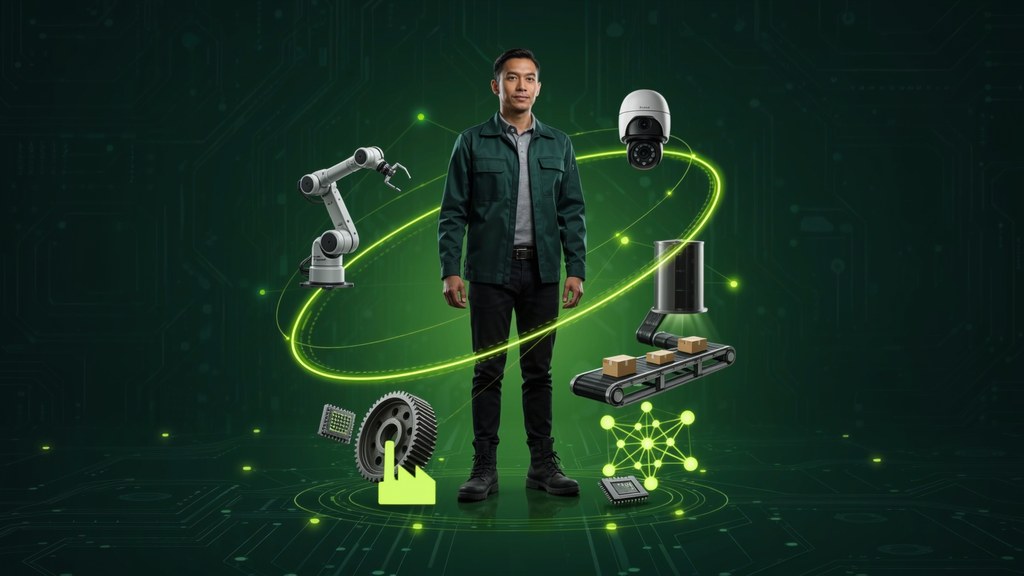
Malaysia's AI career conversation usually happens in one of three rooms: a KL tech office, a Penang design house, or a laptop in a Johor flat with a US client on Zoom. There is a fourth room that almost nobody talks about — the factory floor — and in 2026 it is quietly hiring faster than all of them.
From the electronics assembly lines in Penang and Batu Kawan to the glove plants in Klang, the food processing lines in Shah Alam, and the automotive suppliers clustering around Pasir Gudang, Malaysian manufacturers are bolting cameras, sensors and models onto production lines that ran on human eyes and instinct for thirty years. The government has been pushing this since Industry4WRD in 2018, the National AI Action Plan 2026–2030 has made industrial AI a stated priority, and MIMOS, SIRIM and a growing cohort of local system integrators are all hiring for it. The result is a slice of the AI market where the competition for talent is thinner than the pure-software roles, and the ceiling is higher than people expect.
Why the factory floor became a tech workplace
Three forces collided. First, cost pressure: Malaysian manufacturing wage inflation and competition from lower-cost neighbours pushed plants to squeeze yield, scrap and downtime out of every line. Second, export requirements — especially from automotive and electronics customers in Japan, Europe and the US — started demanding traceability and defect data that simply cannot be produced by manual inspection sheets. Third, the hardware got cheap: industrial cameras, edge boxes and inference chips fell to a price point where a mid-sized plant can justify a pilot without board-level approval.
The policy layer accelerated it. Industry4WRD set the framework and the matching grants, the 12th Malaysia Plan put digital manufacturing into the development budget, and the National AI Action Plan 2026–2030 explicitly names manufacturing among the sectors where AI adoption is a national objective. None of that pays your salary directly, but it does something more useful: it tells every plant manager in the country that their competitors are being incentivised to automate. Nobody wants to be the last manual line in the cluster.
The roles actually hiring in 2026
This is not a market for generic "AI engineer" postings. The jobs split into a handful of concrete titles:
Machine vision engineer — the single most common role. You design defect-detection systems: camera placement, lighting, dataset labelling with the line's own reject samples, model training, and integration into the PLC so a bad unit gets ejected. Every E&E plant, glove maker and packaging line in Penang and Klang wants two or three of these.
AI automation engineer — sits between the process engineers and the software. Writes the Python and glue code that connects MES, SCADA and ERP systems to models, and owns the pipelines that retrain them. JobStreet currently shows roughly 1,400+ AI engineer postings in Malaysia and the automation-heavy manufacturing ones cluster around RM4,000–RM6,000 for juniors, well above a plain controls engineer.
Predictive maintenance data scientist — vibration, thermal and current-signature data from motors, compressors and injection moulding machines, turned into "this bearing fails in ten days" alerts. Unfashionable, deeply valuable, and one of the few AI roles where the ROI is provable in a single quarter.
Edge/MLOps engineer for OT — deploying and monitoring models on the plant floor when there is no stable cloud connection, because factories sit behind segmented networks and you cannot ship every inference to a data centre in Johor and back in 200ms. This is where the MLOps skills article every candidate reads meets a constraint software people never face: the model has to run on a fanless box next to a welding robot.
Robotics and integration specialist — cobots, AMRs, pick-and-place cells. More mechatronics than ML, but increasingly expected to know how to fine-tune a grasp-detection model rather than hand-tune a gripper.
OT cybersecurity analyst — the dark-horse role. Pulling lines onto the network creates a blast radius, and IEC 62443 awareness is now a line item in most customer audits. If you liked the AI security angle but want fewer applicants, this is it.
What it pays
Manufacturing AI pays less than banking and less than remote US contracting — but it also costs less to live where the jobs are, and the premium over traditional manufacturing roles is dramatic.
Realistic 2026 bands, Penang / Johor / Klang Valley:
- Junior machine vision or automation engineer (0–2 years): RM4,000 – RM6,500/month - Mid-level, 3–5 years, owns a line end to end: RM7,000 – RM11,000/month - Senior / lead, multiple lines or multiple plants: RM12,000 – RM18,000/month - Plant-level digitalisation manager or head of Industry 4.0: RM16,000 – RM25,000/month plus bonus - Specialist contractors and consultants (90-day line-rollout projects): RM300 – RM600/day for integrators, and materially higher for independent consultants who can own a whole deployment
Geography matters less than you think. Penang automation roles span roughly RM3,150 on the entry end to RM8,500+ for experienced hires on the platform data; Johor automation engineers sit around RM95,000–RM152,000 a year, which is competitive once you price in Johor's cost of living and the wave of data-centre and semiconductor investment pulling wages up across the causeway corridor. The plants in Batu Kawan, Kulim, Pasir Gudang and Tanjung Manis all have their own bands, and the multi-national suppliers — the automotive Tier 1s and the US/Japanese electronics firms — consistently pay 15–25% above the local SME average for the same skill set.
The underrated part is stability. Software AI hiring is cyclical and brutally so; a plant that has committed RM8 million to an automated line needs people to run it for the next decade. Layoffs in this segment are rare, and the credential you build — "I took this line from 82% to 96% first-pass yield" — is legible to every employer in the country.
Where the jobs actually are
- Penang and Batu Kawan — the epicentre for machine vision, driven by E&E, semiconductor test and medical device manufacturing. - Johor (Pasir Gudang, Kulai, Iskandar Puteri) — automotive suppliers, food and beverage, and the spillover from the data-centre boom pulling in edge infrastructure talent. - Klang Valley and Klang — glove and medical consumables, food processing, logistics-adjacent fulfilment automation. - Kulim, Ipoh, Melaka — second-tier clusters with lower costs and, right now, noticeably less hiring competition.
Government-linked manufacturers, GLC-linked plantations digitising their palm oil processing, SIRIM and MIMOS project roles, and the local system integrators (there are perhaps two dozen credible ones) are the practical entry points when you have no manufacturing experience on your CV.
The skills that transfer — and the ones you must add
If you already write Python, use PyTorch or TensorFlow, and can train an object-detection model, you are 60% qualified. What software AI engineers consistently lack:
- OpenCV and classical vision — lighting, thresholds, contour work. Half of real inspection problems are solved before any model is trained, and candidates who only know transformers get humbled in week one. - The OT vocabulary — what a PLC is, how a ladder program differs from your microservice, why a line stop costs real money per second, and how to talk to a 25-year veteran maintenance technician without either of you resenting it. - Edge deployment — ONNX, TensorRT, quantisation, and running reliably on hardware that cannot be restarted on a whim. - Data hygiene under scarcity — plants generate very few defects per hour. You will build models on 300 images, not 300,000, and you need a plan for that: synthetic augmentation, few-shot approaches, or an honest conversation about what the camera can and cannot catch. - Safety and compliance — ISO standards, customer audit trails, and in some plants, halal or HACCP documentation touching the same line you are deploying to.
Notice what is absent: a computer science degree is not required. Mechatronics, electrical, mechanical and process engineering backgrounds are actively preferred by many plants, because the person who understands the process will always beat the person who only understands the model.
How to break in from outside manufacturing
The pragmatic path is a three-move sequence. First, take a role adjacent to a plant — an integrator, a camera or automation vendor, SIRIM/MIMOS project work — rather than trying to walk in as a pure ML hire. Second, get one deployable proof: a Roboflow or open-source defect dataset taken all the way to an edge demo on a Jetson or a mini-PC, written up with real numbers on latency and accuracy. Third, learn enough OT to be useful on day one — a weekend each on PLC fundamentals and OPC UA will separate you from the dozens of candidates who only bring Kaggle notebooks.
Career switchers from traditional manufacturing have the mirror-image advantage. If you already speak process engineering, your shortest upgrade is Python plus OpenCV plus one vision project, not a two-year data science bootcamp. Employers here will take a process engineer who can code a little over a coder who has never stood next to a running line.
What comes next
The next three years of Malaysian manufacturing AI will be less about novel models and more about deployment at scale: digital twins for line changeovers, generative AI copilots for maintenance technicians querying equipment manuals in Bahasa Malaysia, vision systems moving from inspection into process control, and the first plants running genuinely lights-out shifts. The government's targets under the National AI Action Plan put a number of adoption goals behind that, and every one of them requires bodies on site.
That is the opening. The factory floor is the largest untapped AI talent market in Malaysia — physically present, systematically under-subscribed by candidates who assume "AI career" means a desk in Bangsar South. The lines are already running. Somebody has to make them think.
The bottom line: if you can put a model where it changes a physical outcome — yield, uptime, safety, throughput — Malaysia's manufacturing sector will pay a durable premium for it, and it will still be hiring when the hype cycles elsewhere have moved on.