Malaysia's E-Commerce Boom: The AI Careers Powering the Super-App Economy
Shopee, Grab and the TNG eWallet run on recommendation, pricing and fraud models built in KL. Here are the AI and data careers inside Malaysian e-commerce — the roles, the MYR salaries, and the realistic ways in.
21 September 2026 · 9 min read
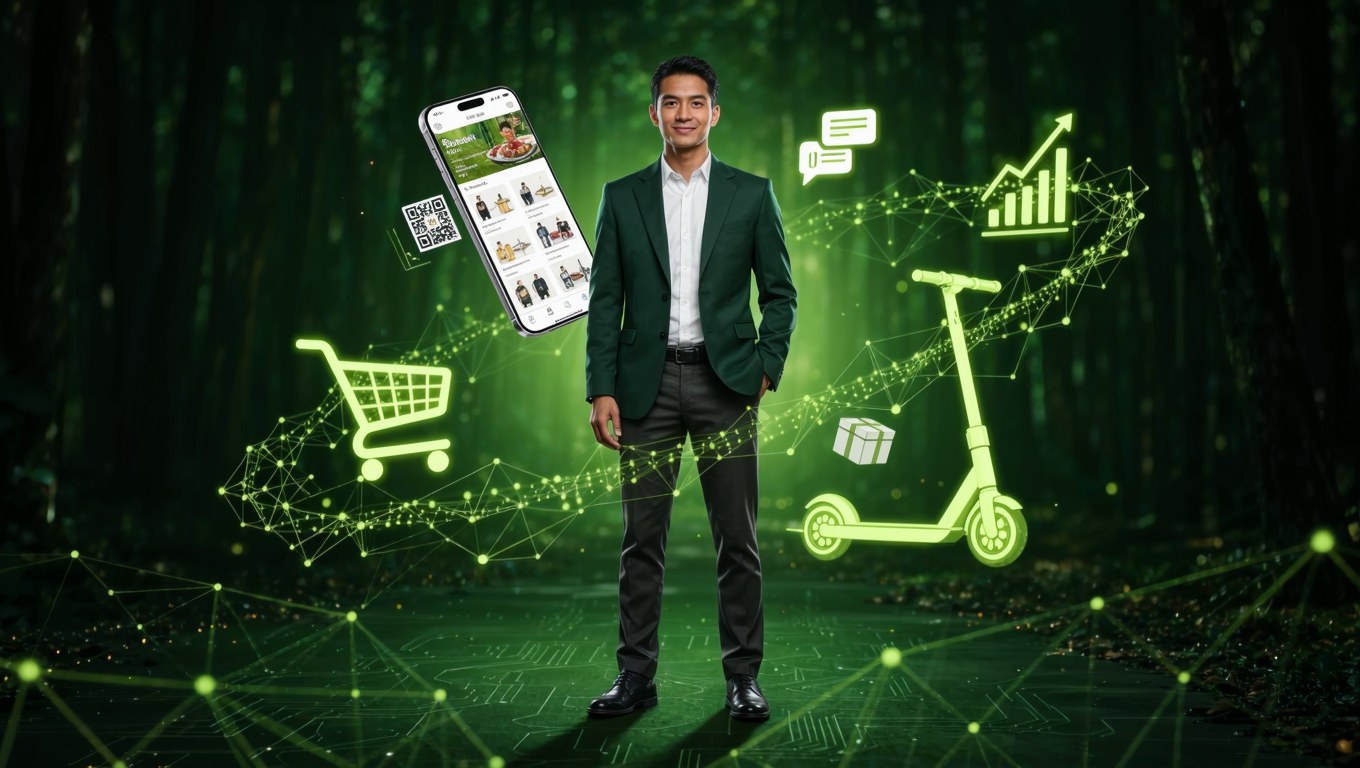
When a shopper opens Shopee at midnight, taps Grab for lunch delivery, or scans the Touch 'n Go eWallet at a mamak, they are being served by an orchestration of machine learning models. Ranking algorithms decide which 30 products fill that first screen. Uplift models assign vouchers. A neural network predicts the arrival time of the rider. A fraud model scores every transaction in under a second. The companies that run these systems are among Malaysia's largest employers of AI talent — and among the least obvious.
Public conversation about AI jobs in Malaysia tends to fixate on data centres in Johor or banking AI in Kuala Lumpur. But the consumer platforms — marketplaces, ride-hailing, e-wallets, last-mile logistics — hire a different kind of AI professional: one who ships to millions of users weekly, is measured on revenue and reliability metrics, and rarely publishes a paper. If you want scale without a research lab, this is where much of it lives.
This article maps AI and data careers in Malaysia's e-commerce and super-app economy in 2026 — who is hiring, the roles behind the checkout button, what they pay in MYR, and the realistic ways in.
Who is actually hiring
Shopee is the dominant marketplace in Malaysia and one of the region's largest technology employers. Its Kuala Lumpur office hosts marketplace data roles — data scientists, business intelligence analysts and regional planning teams — supporting recommendation, search, pricing and logistics across the region. Sea Group's scale means these teams work at volumes local companies simply cannot match: national campaigns, tens of millions of sessions, hourly demand swings.
Grab runs one of its largest engineering hubs in Malaysia and treats the country as a core market rather than a satellite. Its machine learning organisation covers dynamic pricing, driver-partner matching, food delivery ETAs and fraud — with an in-house MLOps platform, Catwalk, managing the full model lifecycle. Roles span ML engineers, data scientists and analytics translators who work directly with product teams.
TNG Digital, the company behind the Touch 'n Go eWallet used by more than 20 million Malaysians, is the super-app economy's stealth AI employer. Its risk and data science teams score transactions in real time, build fraud detection and personalisation models, and increasingly work on credit and merchant analytics. Recent openings have included risk data scientists and data/AI architects based in KL.
Below the big three sit Lazada, Zalora, foodpanda, Carsome, Ninja Van and Pos Malaysia's digital teams — smaller data organisations where a single engineer can own an entire domain, often with less competition per opening. For someone two to three years into a career, these can be better places to accumulate end-to-end ownership than a hyperscale platform where you own one model in a fleet of hundreds.
The roles behind the checkout button
Recommendation and search engineers build the systems that decide what shoppers see: candidate generation, ranking, embeddings, visual search, query understanding. Because Malaysian shoppers search in English, Bahasa Malaysia, Chinese and Tamil, multilingual retrieval is a local advantage — models that handle Manglish queries and mixed-language listings are a genuinely Malaysian problem.
Decision scientists work on prices, vouchers and marketplace incentives. This is applied microeconomics as much as machine learning: causal inference, uplift modelling, incremental impact measurement. Shopee and Lazada hire for this aggressively because a one-ringgit voucher misallocated at platform scale is a nine-figure problem.
Fraud and risk data scientists sit mostly on the payments side of the ecosystem — TNG Digital is the marquee example, alongside the AI teams at banks and e-wallet challengers. Anomaly detection, graph models and device intelligence rule here, and the stakes are tens of millions of ringgit moved daily.
Logistics and ETA engineers keep the promises the app makes. Delivery-time prediction, route optimisation and fleet allocation combine deep learning with classical operations research; Grab's ETA models and Ninja Van's routing work are the reference examples in the region.
GenAI and LLM engineers are the newest and fastest-growing group. Customer support automation, seller copilots, conversational commerce and internal knowledge systems are all being rebuilt around large language models in 2026, and platforms are hiring for this faster than universities can produce specialists.
Data analysts are the volume hire and the front door. Nearly every AI career in e-commerce starts with a SQL-heavy role where you learn the business long before you touch the models.
What it pays in MYR
Reported 2026 ranges show the platform premium clearly. Senior machine learning engineers at Grab are reported between RM19,000 and RM28,000 per month, with leadership roles above RM30,000. Shopee's senior ML engineers are reported slightly higher at RM21,000 to RM32,000. Mid-level data scientists and ML engineers at these companies typically land between RM10,000 and RM16,000, depending on how much production responsibility they carry.
Entry-level analytics roles start far lower — RM4,500 to RM7,500 for junior analysts, rising to RM9,000 to RM13,000 for senior analysts — which is exactly why analytics is the most common entry path. Contract and fixed-term roles, common in regional hubs, often pay a premium over permanent equivalents but strip out bonuses and stock. For listed parents like Sea and Grab, RSU grants can shift total compensation meaningfully above base salary, and should be weighed that way in negotiations.
The honest comparison: banking AI roles in Kuala Lumpur still pay the biggest premium on paper for equivalent seniority, and global remote roles for foreign employers can exceed both. What e-commerce offers instead is scale and speed — models shipped to national audiences, with results measurable in days rather than quarters — and that track record is what makes the next jump easier.
What these teams screen for
The hiring bar at super-apps is production readiness, not notebook fluency. Expect SQL to be tested hard. Python is the working language. For engineering-leaning roles, distributed data tools — Spark, Kafka, Airflow — appear in interviews and daily work. For science-leaning roles, experiment design and causal thinking matter more than deep learning trivia: can you design an A/B test, defend the metric, and kill your own model when it fails?
ML system design interviews are standard at Grab and Shopee for engineering roles: given a problem like delivery-time prediction or fraud scoring, design the data pipeline, the model, the serving layer and the monitoring. Familiarity with the marketplace domain — unit economics, GMV, take rates — is a differentiator most candidates never bother with.
Realistic paths in
The most common route is internally vertical: analyst to senior analyst to data scientist to ML engineer. If you are already working inside an e-commerce company, this path is available and heavily underused.
Software engineers have a second route: own a model end-to-end — training, deployment, monitoring — and apply for ML engineering roles. Platforms value engineering depth highly; a strong backend engineer with one production model beats a mediocre ML specialist.
For fresh graduates, graduate programmes and internships at these companies convert best, and regional platforms hire juniors mostly into analytics and BI. Build one portfolio project that reads as e-commerce — a recommender on a public marketplace dataset, a delivery-time model with an honest evaluation, an A/B analysis written up as a memo — and publish it. Hiring managers do read.
Referrals remain the strongest lever. Malaysia's data community is small and concentrated in KL and Penang; the professionals you meet at meetups are often one message away from an opening, and government upskilling programmes through MDEC exist to widen exactly this funnel.
Why this window matters
Malaysia's super-apps are at an inflection point. The classic stack — ranking, pricing, ETA — is mature, but it is now being re-tooled around large language models and agentic systems, from seller copilots to conversational shopping. Teams are being rebuilt, roles are being redefined, and domain knowledge plus the new tooling is a rare combination.
The e-commerce AI job market is not as loud as the data centre buildout or the banking AI boom. It is, however, where the country's highest-volume machine learning problems live — and it is hiring.