The Agentic AI Engineer: Malaysia's Fastest-Growing Role in 2026
Job postings for agentic AI engineers are multiplying across Malaysia's banking, fintech, and enterprise sectors — and the role is fundamentally different from the ML engineering that preceded it.
20 May 2026 · 7 min read

The job posting was straightforward: "Agentic AI Engineer, up to RM 15,000." It appeared on Randstad Malaysia's listings in early 2026 and described something fundamentally different from the ML engineer roles that have dominated Malaysian AI hiring for the past five years. This was not a role about building models. It was about building systems that make decisions.
The agentic AI engineer is the fastest-growing new role in Malaysia's AI job market this year — and it is poorly understood by both the professionals being recruited into it and the organisations doing the recruiting.
What agentic AI actually means
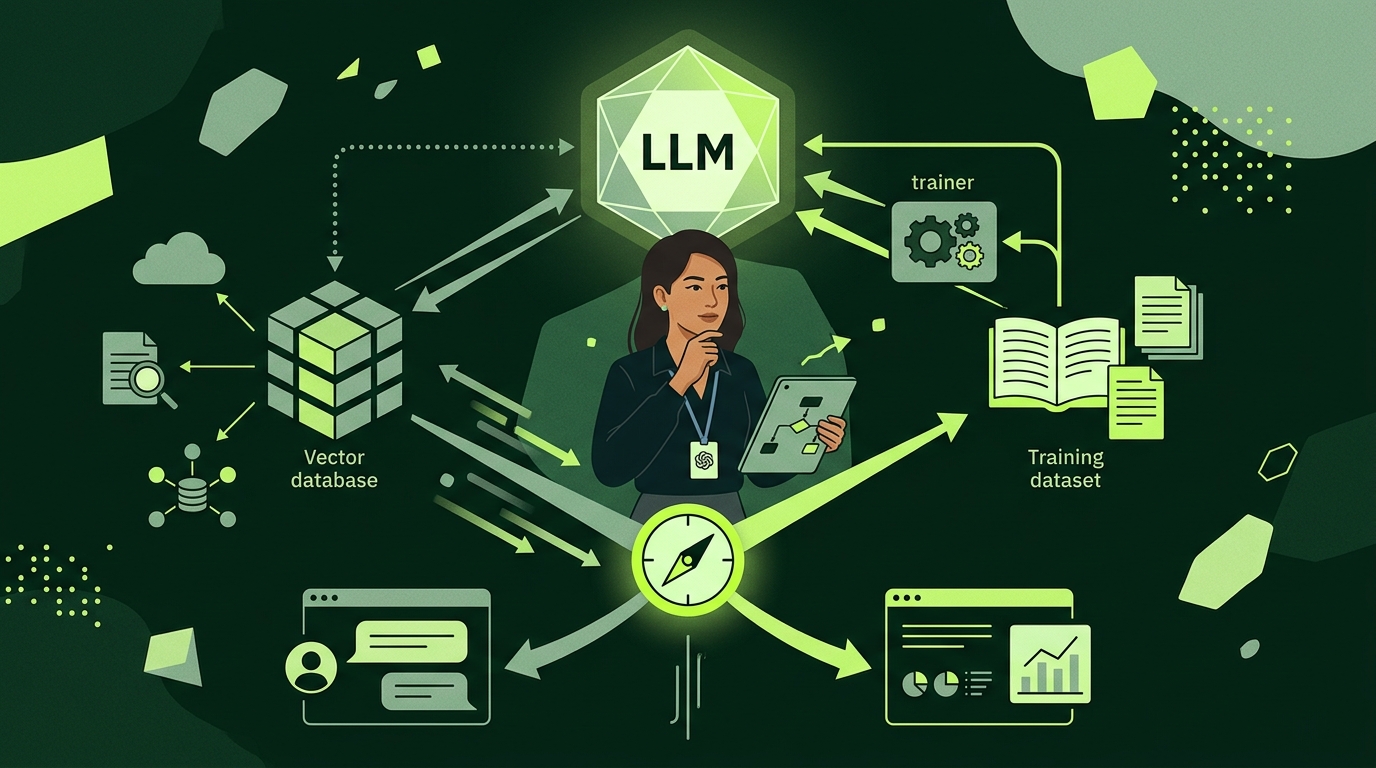
"Agentic" refers to AI systems that do not just respond to a single query but operate autonomously across multi-step workflows — taking actions, using tools, evaluating results, and adjusting course without a human in the loop for each step. An agentic system can be given an objective ("compile a due diligence report on this company") and execute dozens of sub-tasks: searching databases, querying APIs, reading documents, cross-referencing sources, and assembling an output.
This distinction matters for career planning because it describes a different engineering discipline. Building an agentic system requires not just ML knowledge but software architecture skills: how to design reliable tool use, how to handle partial failures in multi-step pipelines, how to manage context windows across long-running tasks, and how to evaluate systems whose outputs are complex and variable.
The stack you need to know
Job listings in Malaysia for agentic AI roles converge on a consistent technical profile. Python is the baseline — no different from other AI roles. What distinguishes agentic engineering is the frameworks layer: LangChain and LlamaIndex for orchestration, with increasing mentions of LangGraph for stateful multi-agent workflows.
Function calling — the mechanism by which LLMs trigger external tools — is a core competency. Engineers need to understand how to design reliable tool schemas, handle malformed tool calls gracefully, and build the evaluation pipelines that verify the agent is doing the right thing. Memory systems (both short-term context management and longer-term vector store memory) are increasingly part of the picture as agents become more persistent across sessions.
Cloud infrastructure knowledge is expected: AWS Bedrock, Azure AI Studio, and Google Vertex AI all have first-party agent frameworks, and Malaysian employers across banking, insurance, and enterprise software are using all three.
Who is hiring in Malaysia
Demand is concentrated in three sectors. Financial services — banks, insurance companies, and fintechs — are deploying agents for back-office automation: document processing, compliance checking, and report generation. Enterprise software companies are building agent-powered features into existing products. And a growing number of AI-native startups is building agent infrastructure itself.
The 700-plus AI engineer roles visible on Indeed Malaysia in May 2026 represent a market that has roughly doubled in available positions since early 2025. Agentic roles are a growing subset of that, and they tend to pay at the upper end of the AI engineering range. The average AI engineer in Malaysia earns around RM 150,000 per year (roughly RM 12,500 per month); agentic specialists with production experience are consistently landing above that figure.
What makes an experienced engineer transition-ready
The move from standard ML engineering or backend software engineering into agentic AI is more achievable than most professionals think. The gap is primarily in framework familiarity and in developing the right mental model for debugging non-deterministic systems.
Engineers from an ML background already understand probabilistic outputs — an advantage, since agentic systems require tolerance for results that vary across runs. The new skill is designing for that variability: graceful fallbacks, output validation layers, and confidence-based routing.
Engineers from a backend software background bring strong system design instincts that translate directly. Their learning curve is primarily in LLM behaviour: context management, token limits, prompt sensitivity, and when to trust model judgment versus when to constrain it with explicit logic.
How to break in practically
The most useful first project is a simple but complete agentic system: pick one business-relevant task — invoice extraction, research summarisation, FAQ routing — give it access to two or three tools, and build it end-to-end including evaluation. Agentic systems are evaluated differently from classification models; the metrics include task completion rate, tool call accuracy, and latency across the full pipeline.
Document the architecture decisions, not just the implementation. Malaysian AI employers hiring for agentic roles are looking for judgment as much as code. Understanding why you made certain design choices tells an interviewer significantly more than the fact that the system works. Build the project, write it up clearly, and put it in public — that is the credential that currently moves the conversation forward.